Saturday, July 20, 2013

Realizing the Plan of Happiness

The underlying fear I have noticed from all of the responses I received is the fear associated with the plan of happiness. And overall the fear is associated with lack of understanding pertaining to Heavenly Father's plan. Daniel Judd writes about the importance of understanding this plan in the 23rd Chapter of Successful Marriages & Families.

Overall, Judd doesn't speak on anything more than what we have already about the Plan of Salvation. He talks about the creation, the fall, and the atonement of Jesus Christ. Judd's focus is more on the importance of understanding this plan of happiness.

He explains, "Although the exact nature of family relationships after this life has not been fully revealed and we do not fully comprehend what God has prepared for the righteous, the Lord has revealed that marriage is essential for exaltation in the celestial kingdom."

I had an opportunity to present this information to everyone that I interviewed, regardless of the fear they mentioned. I went to each person one by one and recited this quote for them, asking them what their overall reaction was. I received several reactions from each person. Each person always started their response saying they know this information and this was something they've been taught several times. I then asked them what spiritual implications this had and how that related to their fear. I will highlight some of the responses I got:
"...I think the hardest thing for me to do is realize that the Lord has created this plan as a plan for happiness. I sometimes get so caught up in the trials that I forget the Lord wants me to be happy. How can I be happy when I'm afraid of the very thing that is designed to make me happy?"
"The days when I know what the plan of happiness is are the days I see the Lord for who He really is.
"This is actually the first time I thought of how this might apply to my trial. I'm sure I've heard this before in Sunday School lessons but I never thought of how the plan of happiness related to my trials. I always thought of the plan as doctrine pertaining to family. But now that you mention that I can see that the plan is really about God's love for me. He loves me and so He made this plan. That makes me feel good actually...I feel like I'm finding comfort in my trials for the first time, like true comfort.

More than anything these posts are intended to bring to light what many people fear pertaining to family and allow them to learn from that fear. Life has many obstacles and it will continue to have more. We will battle infertility, loss of a family member, feelings of abandonment and loneliness, loss of friendships, etc. These trials will come without warning most of the time and we will still be expected to continue with life normally. This book has provided me with more insight with the antithesis to the fears we have. For every fear there is gospel principle designed to help us. My hope is that anyone who reads this can see the benefit in the family, the gospel of Jesus Christ and the hope it provides.

Know that you are loved and cared for. Don't ever give up on your quest toward happiness.
Supporting the Family Policies

One thing that seems to be attacked more in our society than ever before is the definition of the family. The family unit is so vital to our happiness and yet there are so few people who have taken a direct stand to protect the family.

In Chapter 28 of Successful Marriages & Families, Michael Seipel discusses the role our government plays in the definition of the family as well as the development of the emotions surrounding it. One thing Seipel points out is that there are several developed countries that have benefits directly tied to the family. One example would be France, where there are services available to provide direct families with benefits towards child rearing. In these countries the government's role is accepted and appreciated. However, some argue that the government has no place in the matters of the family. The United States has mostly stayed away from in depth involvement in the family, though there are some services that are meant to directly assist families. The medical insurances, for example, that are available for poor families with children are meant to provide every child with healthcare to further assist them in their development. Some other services were created to assist the family, such as Social Security, however some people have misunderstood its purpose and used this program as a method for their own retirement accounts. The welfare program was designed as a temporary relief for families where their circumstances have not allowed for a parent or both parents to work. There are several state programs designed for this as well. Unfortunately, this program has been seen by some as a method of acquiring money without having to work.

Despite the negative association with some of these programs, there are some programs and laws that have been developed for the sole benefit of the family and Seipel provides explanation of such programs and laws. One is the Living Wage Law. This law was designed to be timed just perfectly so that the low-income worker can climb out of poverty. The current minimum wage is $7.25 per hour. Seipel explains, "[The] full-time workers working all year long will earn $13,920-far short of the $18,310 federal poverty guideline for a family of three." He explains that the law is not in full support as it should be but that there are some states that are rising to the opportunity to support this law. We are citizens can find out more about what we can do to help by researching this policy.

Another law is Earned Income Tax Credit. Seipel explains the benefit of the program:
All low-wage workers qualify for the program. The value of EITC that a family receives depends on the family's income and size. The  benefits increase as earnings rise until they reach an income of $12,030 for a couple with two children...For example, a married couple with two children receives a maximum benefit of $4,824 as their income reaches $12,060. Once the worker's income exceeds that level, the benefits begin to decline and are phased out completely as they reach a maximum income of $41,646...Thus the program encourages people to earn as much as they can without fear of losing all benefits.
These two laws are just two of many that have been passed to provide more relief for struggling families and support for them. And while these programs are not perfect, they are designed to support the family and we as a society can help by supporting these laws and programs as well as educating ourselves on them. Through our participation we can make a difference on our society. There is plenty of work to do.

Here's another article that might help.

Finding Peace in the Midst of Pain

W. David Robinson, Jason Carroll and Elaine Marshall start Chapter 23 of Successful Marriages & Families with a quote:
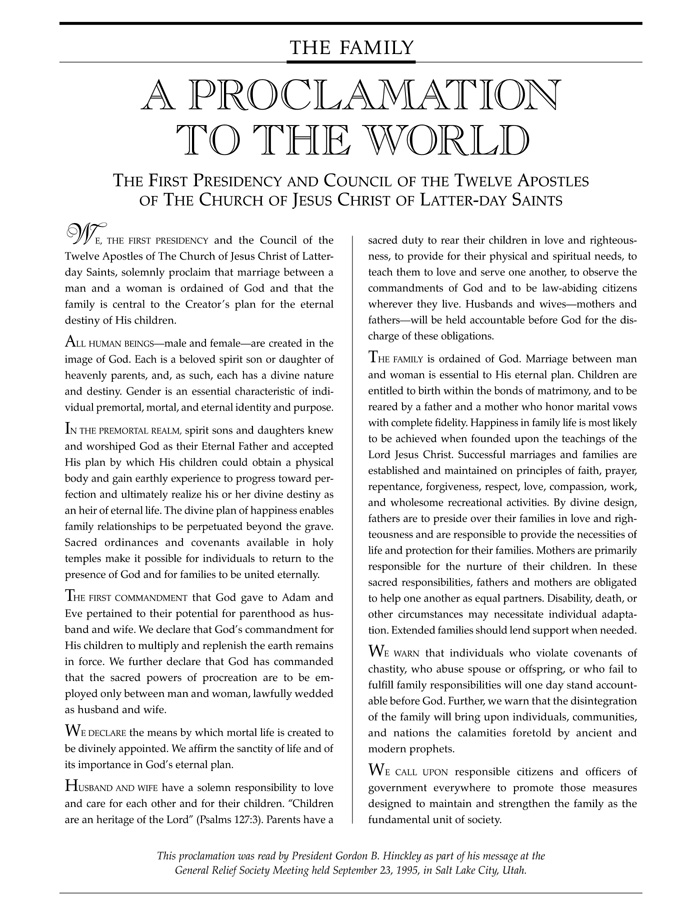
In the premortal realm, spirit sons and daughters...accepted [God's] plan by which his children could obtain a physical body and gain earthly experience to progress toward perfection...The divine plan of happiness enables family relationships to be perpetuated beyond the grave.
This post is going to talk most about how to heal after losing a loved one in the family. I spoke to someone who dealt with this issue and I quoted them in one of my other posts. I also posted a Mormon Message that talks about what one man had to overcome after losing several family members in a car accident. For this post, I thought I would let the words of the authors speak for themselves, as this is a very difficult subject for many who have gone through it and having not had to battle this personally I thought they would be able to shed more wisdom than I.

The authors begin the chapter quoting President James E. Faust. Faust expresses the type of pain that comes from such painful circumstances but offers council on the hope that can result from spiritual healing through knowledge of the plan of happiness:
Into every life there come the painful, despairing days of adversity and buffeting. There seems to be a full measure of anguish, sorrow and often heartbreak for everyone  including those who earnestly seek to do right and be faithful...[This] refining process...often seems cruel and hard [and] for some the refiner's fire causes a loss of belief and faith in God, but those with eternal perspective understand that such refining is part of the perfection process. 
The authors continue to write about the importance of finding meaning in the struggles we go through in our families. They teach that the truths of the gospel give us an opportunity to find spiritual comfort in the midst of our trials. And though it may not be simple to see the "bright side" of things, we can always find it if we look for it. Understanding the Atonement can offer us peace and comfort, for when there seems to be no one around who could possibly understand our pain, there is one who suffered all things for us: Jesus Christ.

It seems then that  the way to overcome the adversity and pain caused by a trial is to grow in faith. If we can learn to understand our Heavenly Father's plan for us we can start to see our life through His eyes. This is a lesson I have had to learn as well.

A couple of months ago I learned through medical tests that I do not naturally ovulate very well. My husband and I have been trying for children since October 2012 but I have a history of amenorrhea so I knew we might have trouble. My fear was confirmed through the blood tests I got. I started out this trial thinking selfishly: Why am I not pregnant? Am I not worthy enough? How come these teenage girls who are way too young to be mom's are getting the chance and here I am fighting for something that the Lord has commanded us to do? That was the first stage. The second stage was questioning what exactly faith meant. Does faith mean that I'll believe in God so long as I get my way? Certainly not. Does faith mean that if the Lord doesn't give me the chance to be a mom right now that he must not see me as worthy? Definitely not. Faith, I had to learn, was an eternal principle based on knowledge of things as the actually are, not as I desire them to be. The third stage was then changing my perspective. I began this trial feeling like I was being punished. I have gotten to the point now where I can see the blessings despite the pain. I can see how the Lord has still provided for me even though I'm not pregnant yet. He has still given me amazing blessings. And I have learned that what I don't have should not be a measure of the Lord's love for me. Instead I have to look at what I do have.

More than anything this post is about opening the heart enough to allow a different perspective to enter. It is about realizing what the most important things in life are about. It is about seeing more than just the loss. It is about counting blessings and finding comfort through the strength of others as well as the life of Jesus Christ.

Here's my blog where I've written about my own struggles with fertility. I hope the information I have provided can be helpful for someone out there.

Monday, July 15, 2013

Finding the Time for Family

Mark Widmer and Stacy Taniguchi address an important aspect of the family in Chapter 22 of Successful Marriages and Families: Wholesome Recreation. In a day where Facebook, cell phones and internet take most of the attention we deserve as parents away from us, finding wholesome recreational activities becomes difficult. Lately people have lost more patience and have found it more difficult over time to sit through any one activity for longer than 5 minutes. The activity has to be extremely interesting in order to capture the attention of children/teens/young adults. Widmer and Taniguchi give some advice on what parents can do.

Try to find activities for teens that might help them to identify their skills with activities. Widmer and Taniguchi wrote, "As [teenagers] engage in specific activities and develop higher levels of skill, the activities and skills become integrated into their identities. For example, teenagers who study and learn music begin to see themselves as musical." Starting out with activities that you know may cultivate the skills your teen already has may help them to develop their identity and will provide the family with an opportunity to share in that experience. A concert would be great for a musician, a sports game for a sports fanatic, or a fine dining restaurant for culinary skill sets. 

Don't be afraid to play with your children. Sometimes parents feel that their children should play with other children but there are remarkable benefits when parents play with their kids. Widmer and Taniguchi write, "Parents interested in helping their children become flexible and curious should spend quality playtime with them and model good sportsmanship, kindness and fair play. Time spent playing with children also helps them become more secure and independent". Board games are a great way to teach children to take turns and follow rules. Outdoor games will encourage children to get active. Playing with toys teaches children how to interact in social settings. All of these activities would be wholesome family activities for everyone.

Finally, don't feel the need to have the same interests in recreational activities as your spouse. There are several activities we can do but they don't have to be interesting to everyone. Widmer and Taniguchi wrote, "You might think the secret to a great marriage is finding a spouse who loves the same recreational activities that you do. marital satisfaction and stability, however, do not depend on similar recreational interests. For example, research suggests participating in activities both partners enjoy is only moderately related to the husband's marital satisfaction". So if one person love hiking and the other enjoys stargazing, perhaps the couple can hike and once that is done, plop down and stargaze. This could apply to children as well. If one child wants to go out to eat and the other wants to go to a football game, perhaps both could be accomplished. Everyone doesn't have to have the same interests in order to make good use of family recreation. 

The best thing to do is get out there and start. If you can make time for it, you'll be surprised how much it brings your family together. 

The Wayward Child

I am the first person in my family to join The Church of Jesus Christ of Latter-day Saints and having done so I am used to having family members who are not sealed with me in the temple. My husband is the first person who I am sealed to and I am his as well. Coming from this background we have never had to experience the sibling who grew up in the same house as you and yet has lost their testimony of the gospel. Regardless of whether it has happened to us in the past or whether it is part of the future for our family, however, every family will have to face this trial.

My friend Afton got married over 2 years ago. She was married in the temple to her returned missionary husband when she was 19 years old. This friend is the person who introduced me to the gospel when I was in high school and I took the missionary lessons in her home with her entire family. Currently her two brothers and her husband are all inactive. I was talking to her about the feelings she had based on that. Here is what she said:
The hardest part is feeling like I may never see them come back to the church ever. I don't know if they're going to ever regain the testimony they had for so long. I sometimes get so worried about my brothers because I don't understand how they could have gone away from the church and they were in the same house as me. I'm not sure when this trial is going to end and that scares me. Is my husband ever going to come back to the church? 
In Chapter 16 of Successful Marriages & Families an experience is recounted of a father who had to turn his daughter away from the home. "I remember lying on the bed....sobbing that I wanted my child back, pure and innocent and part of the family again...how can a father kick one of his daughters out of the home?"

The Prophet Joseph Smith taught an important principle during his ministry:
When a seal is put upon the father and mother, it secures their posterity, so that they cannot be lost, but will be saved by virtue of the covenant of their father and mother.
One of the hardest things any one of us may face in this life is the loss of our children. Either our children may be lost due to illness, as was mentioned before, or they may let go of their testimony of the gospel. At any rate, it is important to know that all is not lost. The Lord will be there for us during a trial such as that and our covenants can still be preserved. I decided to talk to Afton's mom Julia on what has helped her to deal with the trial she is going through from her two sons being inactive. Here's what she had to say:
I feel guilty sometimes. Sometimes I sit and think of what I didn't do that maybe I should have. But most days I remember the Lord knows me. He knows my kids. And He loves them anyway. So in that sense, why can't I? The Lord wouldn't give up on anyone. I can't give up either. It'll work out and I'll just love them in the meantime....the best advice I'd give is to stay strong. Keep hoping. 


Saturday, July 6, 2013

Knowing How To Let Go

This one is another personal experience, but this time from my husband's life. Knowing that my husband suffered from a broken home situation when he was younger, I have been very intrigued by his attitude on his family. That attitude has helped me with a fear I had pertaining to family: not being able to forgive.

My husband's mother was pregnant at a young age. When she told my husband's father, he wanted nothing to do with it. She started to consider having an abortion. She didn't feel she was ready to be a mother and knew she would not be able to provide the life for him. Also the father was out of the picture, wanting nothing to do with the situation at all. As she really thought about it, however, she started to feel guilty about the idea. She decided to keep the child anyway. My husband was born and raised by his father's parents first and then by both the biological father and then by the mother throughout the years. Having gone back and forth from one parent to the other created a very inconsistent upbringing for him and developed into feelings of tension. He is still in contact with his both his parents and although he loves them he does not ever want to live with them. There are several situations he outlined for me that I will not share because of their personal nature. It suffices to say he did not have a great upbringing but still seems to love his family.

When he first told me all of this, I asked him "How do you not have feelings of tension towards them? How do you still feel like you can talk to them all the time and not be offended from the choices they made?"

He explained that he has learned to forgive his parents because of what the Lord has promised to those who do. He has felt the peace from letting go of the pain he felt from them and he has felt the joy that took its place.

Elaine Walton and Hilary Hendricks mentioned this idea as well and expresses words of wisdom regarding it:
Interpersonal transgressions are common occurrences in all families. They range from misunderstandings and minor mistakes, such as forgetting to take out the garbage, to more substantive disagreements such as [children's]altercation[s] with [siblings], and grievous sins, such as abuse...although the process of repentance and forgiveness is interpersonal, successful outcomes are profoundly intrapersonal--experienced individually, apart from or in addition to any interpersonal interaction.
 Healing from pain caused by family members can feel like a very difficult thing to do and overall it is a challenge. However, just as Walton and Hendricks pointed out it can lead to a healing process for all involved. Having come from an abusive home it has been difficult sometimes to forgive my father for the daily trespasses he makes against me and my family members. However, learning to let go of that pain will put me in a place of greater peace and joy than I would have imagined otherwise. And that is worth finding, in my opinion.

Reference


How Should I Parent?

I don't have many friends with kids, as I am only recently married. But I did have one who has a daughter and a son on the way. I asked her what fears she had regarding parenting. This was her response:
Oh man, like what doesn't scare me about it! I feel like there's so many crazies out there and it's like they are waiting to take my daughter down to hell with them. Seriously! Don't laugh, but I really feel like that. Like they are trying to take away my kids! I feel like when it comes time to send my kids to school they're going to get corrupted! It's a constant fear and I don't even know what I'm gonna do. My husband thinks I'm wacko for thinking these things in the first place. He says I should try to have faith in them. Sometimes, now don't judge me...sometimes I honestly wish I would have waited to have kids. I just feel like I'm not mature enough sometimes to know how to protect them. Not that being older would have made it easier I guess...but maybe I would know a little more about what to do? I don't know. Anyway, it's scary!
 There are many LDS members becoming parents every day and the fears of my friend are no stranger to many of the young parents in our church. Several authors dedicate Chapter 10 to just such fears by indicating the need for "inspired, eternal parenting principles that are based on the proclamation and supported by empirical and conceptual scholarship".

First,  we have to realize that every person who comes to this earth has their own personality and their own genetic traits. In other words, there is no "one size fits all" parenting style. One of the best ways we can parent in this situation is to recognize that just as the proclamation says each individual comes with their own spiritual identity. It is a parent's job to identify that identity and cultivate it, providing a nurturing environment for it. The authors explain, "The way individual children respond to their earthly environments is greatly influenced by their spiritual identity and the spiritual gifts cultivated in the premortal realm". Keeping this in mind may help us to see our child eternally, not temporally.

Second, they emphasizes the need for us to parent with love and righteousness. He says, "Important principles found in the scriptures and the proclamation have been taught throughout the ages to assist parents to 'rear their children in love and righteousness' and adapt to child individuality." Each child is going to be different, as each had a different pre-mortal identity. It is not our task as parents to expect our children to all be exactly like us, exactly like each other or exactly like other kids in the church. Each child will be individual and will need our help to support their individuality and sustain their character.

Finally, they teach we need to maintain a strong and positive influence on children. Without our constant strength and influence, we cannot expect our children to turn out better than the world for it will be the world that teaches them. My friend had the idea that the world would shape her children no matter what. But she has not considered that perhaps with her strong influence her children will be able to overcome the world and stay to the true principles they were taught since birth.

I shared all of these things with my friend. It was amazing to see how quickly she turned her thought process around. She was suddenly apologizing for ever doubting her children in the first place. She started feeling like her husband was right, she did not enough faith in them. I assured her that the fears she felt were not just hers. I told her that many people must feel that way and that I could see myself feeling a little afraid about it all. But that the important thing is to recognize that there is a better way to think and if we think that way we will see our children become people we would have never imagined. Knowing that gave her comfort and she was suddenly not the parent who didn't know what she was doing but the parent who was learning how to nurture her children. I'm glad the authors were able to do that for her.

Reference